

Articles
A Small Linear Accelerator for Charged Microparticles
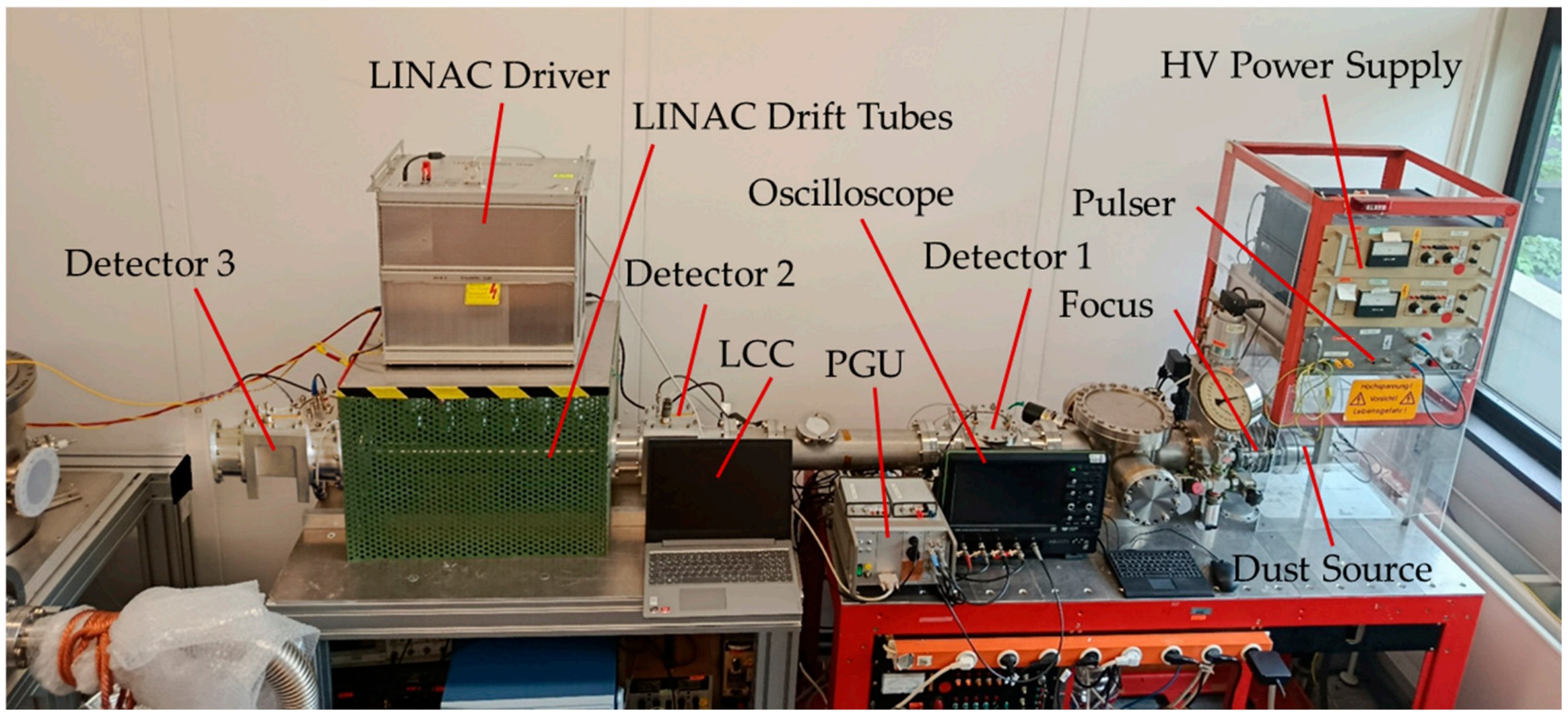
Abstract: Researching cosmic dust requires terrestrial facilities for accelerating analogues of different sizes and masses. To address the area of very lightweight particles, electrostatic accelerators like Van de Graaf accelerators or Linear Accelerators (LINACs) have proven adequate. This article describes the components, dimensions, working principle and attributes of a variable frequency switched 6-stage LINAC of 120 kilovolts (kV) potential based at the Institute of Space Systems, University of Stuttgart. It utilizes negative voltages, no storage capacitors, isometric drift tubes, one semiconductor-based high-voltage switch per stage and there is no voltage drop during acceleration. The particle rate can reach up to 33 particles per second. By setting a target speed window, it autonomously chooses the right number of acceleration stages to meet that requirement, if possible. Micron-sized iron particles were accelerated successfully, achieving speed increase rates of up to three times the pre-LINAC speed and a total speed of up to 1300 m/s. This platform provides a new tool for dust sensor calibration, impact physics and material surface processing due to its ability to bring particles of different charge-to-mass ratios to a defined target speed.
Metal particle acceleration to supersonic speed: Numerical simulation and preliminary results
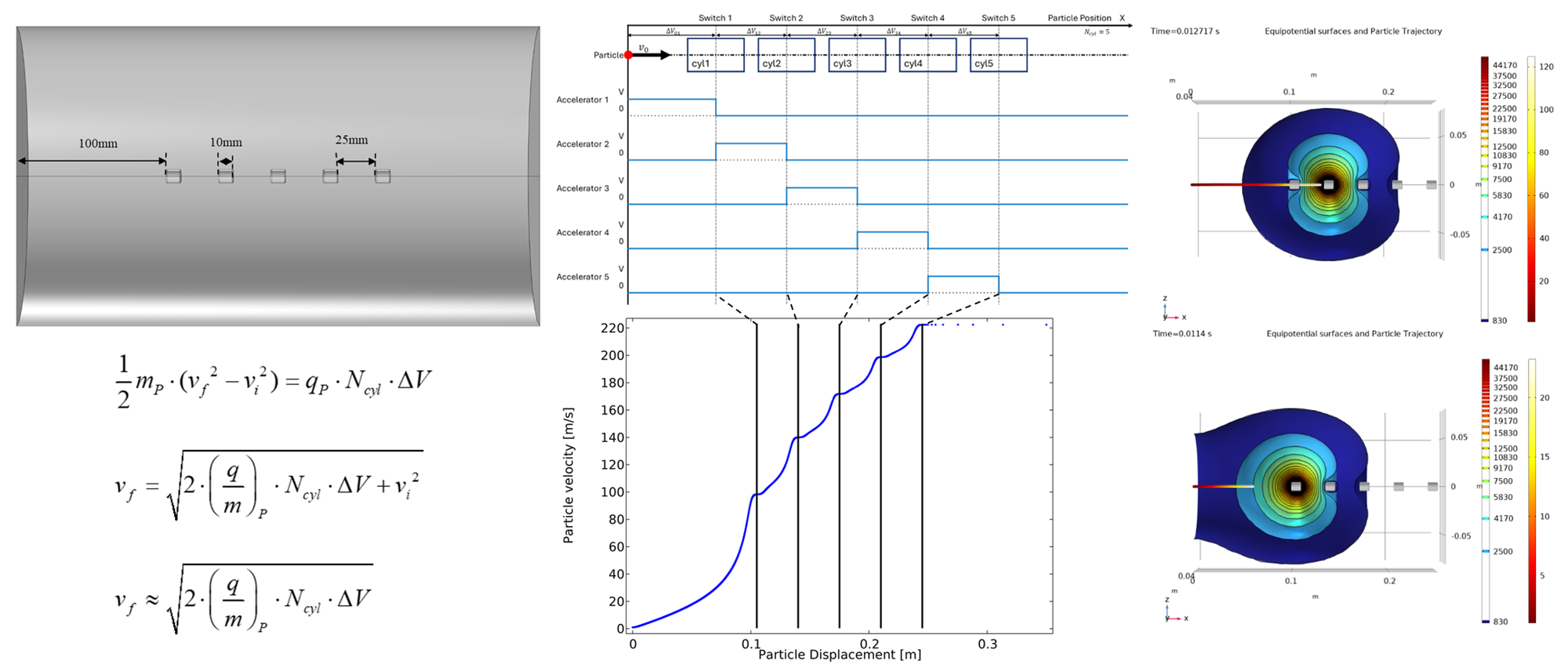
Abstract: Cold spray, because of its solid-state deposition nature retains the original properties of the feedstock to produce oxide-free deposits and not adversely affect underlying substrate material during manufacturing while maintaining high deposition rate. However, deposition accuracy, high operational cost for high velocity requirements, are some of the few limitations that are yet to be addressed. This work explores a novel solid-state deposition principle using a linear accelerator (LINAC) system, inspired by the cold spray process where material deposition and bonding occur through high plastic deformation. The purpose of this study is to validate the concept using numerical simulation model. It includes assessing the influence of applied electric field on charged particle using high voltage cylindrical accelerators. Influence of different parameters on final particle velocity like applied voltage V, number of accelerators N and charge-to-mass ratio q/m are analyzed by simulating model for three different parameter conditions and compared with the formulation. Compared to the conventional cold spray process, this proposed method offers better control over particle velocity and deposition accuracy through electric field modulation, improving resolution for intricate structures.
Conferences
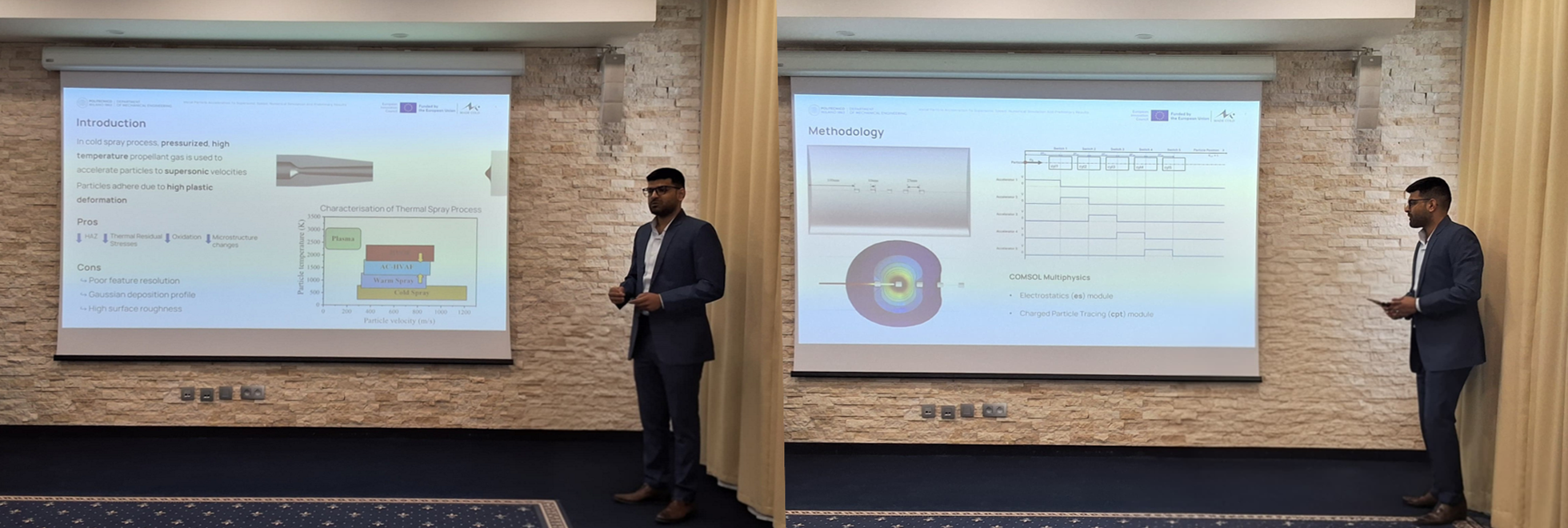
16th International Scientific Conference on Sustainable, Modern and Safe Transport (TRANSCOM 2025) - Slovakia, 21-23 May 2025
Title: A novel process for solid state metal powder deposition: the principles and preliminary results
Authors: Monil Mihirbhai Thakkar, Armir Ardeshiri Lordejani, Yanwei Li, Mario Guagliano